Friday, September 30, 2022

Reunions

 Beggars clustered at the far end of the square. Not daring to move closer to the town gates lest they face the potentially murderous wrath of Duke Gratano’s men. All were in rags, and most had no shirt at all. The stench of their unwashed bodies was apparent even at twenty paces.

The most desperate among them wore nothing, their naked and emaciated flesh tinged a fireweed orange. Broken shells of men, they crouched in the shadows. But their eyes were hungry. One fiend, whom even the other addicts shied away from, had skin covered with reddish boils and was giving off a particularly hateful odor.

All the beggars seemed to shout at once as Tagus and his friends approached.

“Spare a vint, sir…”

“A vint, oh gracious lady, I have children…”

But Tagus was looking at one man in particular. Broad shouldered, he was standing, with difficulty, on one leg. The other was gone, its stump hidden by a mass of rags that might once have been a tunic. His back was bent almost double, his haggard face lined with cracks and wrinkles, but Tagus could see the withered remnants of a soldier’s muscular frame in the man’s bony arms and once barrel-like chest. His head was bald and his dark skin looked as though it had been burnt by the sun. His face was dominated by an unkempt beard, and there was still a twinkle in those deep-set eyes that had shone so brightly in the heat of battle. 

Those eyes turned to him, and each man recognized the other.

“Rigo…?”

The man’s wide mouth opened, and a wheezy yet full-bodied laugh burst forth from a nearly toothless maw.

“Tagus! By our goddess of the shithouse, the hero is coming!”

The laugh turned into a violent hacking cough, but the grin remained.

Aileanor glanced at the beggar in alarm, and Meno jerked his head to one side at the sound of his ally’s name.

“A blive morning to my old comrade in arms,” Rigo shouted, “I thought I saw the last of ya’ when you took that little splash at Allia Bridge! Guess our heretic gods are still smilin’ on your sorry ass!”

“Good sir, there must be some mistake…”

Meno hastily tried to interject, but the beggar furiously rounded on the gnome, causing him to jump back.

“Shut up, you mangy little bug,” Rigo bellowed, “or I’ll thump you good! I be talking to my old soldier friend here!”

The angry roar faded into a dry chuckle as the big man returned his attention to Tagus.

“So, you finally gave up too, eh? I told Tarquinus years ago that he should give up chasing miracles and earn some decent coin. The gods never meant for us to be passive bloody monks without a pot to piss in. Of course, he never listened, the old pin head…how’s the skinny fellow doing anyhow?”

Tagus had not seen Rigo since he had walked out of the Black Horseman three years ago, choosing to abandon the sworn brotherhood of the Falhorne rather than give up the mercenary life. He had been a loudmouth boaster who always loved a good scrap, especially when his friend Tarquinus was involved. Nor had he been one for religion, obeying the Order’s strictures more as formality than anything else. But Vitus had always overlooked this because he followed orders and was utterly lethal on the battlefield. He had served at Fallonier Fields and the Braxian Civil War, before the laws changed and the money ran out, along with his patience. Looking at him now, it seemed that Tarquinus, in dying in defense of the Asylum, had been the lucky one.

“He was killed in battle, Rigo,” Tagus replied tersely, knowing that he shouldn’t, but it just felt wrong to deny it to a former Falhorne down on his luck. Even if the crippled man had no honor.

“Brother Tarquinus fought bravely to the end. Unlike you.”

“Damn, that’s a shame,” Rigo said through a half-smirk, ignoring the obvious look of disapproval in his former comrade’s eye. 

“I liked him. Just never understood why he chose guard duty over mercenary work. It looks like faith did about as much good for him as it did for me. Still, going down fighting is better than this shit. I guess I can’t blame him…”

“You have only yourself to blame.”

Tagus tried to sound indignant, although in truth he did not know what to feel. The renegade Falhorne had abandoned his brethren for gold. At the same time that Porus had met his fate on the gallows after defending the Order’s principles to the end. Yet Rigo’s piteous state hardly inspired anger.

The beggarman gestured all around: to the rags at his waist, the stump of his leg, and grimaced bitterly.

“Ha! Tell your praetor that he’s had his revenge on me and then some,” he spat. “It’s been two years since I lost my leg fighting those bloody Braxians. Serves me right for agreeing to return to that cursed country. The King of Galthran smashed that simpleton Tilly and I barely made it out alive. It took all my wages just to get a wagon ride back south. Even lost my shirt, I did…had to sell it to buy food. Never sold my pride though; a soldier never loses that! Just ask the bandit scum who tried to stop me outside Brisi. I bashed his damn brains out!”

Tagus glanced nervously over his shoulder as Rigo again burst out laughing. Still, the bombast of this old soldier with a begging bowl was enough to put a half-smile on his face. He had to remind himself that the one-legged man was a coward and a deserter.

“He must have been one stupid bandit.”

“Damn right!”

Rigo’s laugh was hoarse, yet still forceful.

“The nerve of some bastards! So how have you been keeping, you bloody puritan? You can’t be living by the Book if you’re out in these parts. I take it Vitus finally disowned you for some stupid reason or other…”

Tagus could only shrug his shoulders against the pain, not wanting to explain the details of what had befallen him since his old life went up in flames. Nor did the wretched Rigo deserve to hear what had happened to his former home.

“I remain what I am,” he said, “And from what you tell me, so does the northern war.”

Rigo chuckled wickedly in response, his withered belly shaking.

“Gormani’s flames, boy, that war will never end! Those nobles breed like rabbits. No sooner does one of em’ fall, the son steps into papa’s armor and herds another lot of peasants to the slaughter. Margrave Tilly’s grandson’s leading his house now, with the personal blessing of His Holiness the Hierophant I might add. Seems he’s decided that the boy’s the chosen of the Most High, come to purify the Braxian reaches of heresy. And before I hobbled out of there, some of the men told me that Duke Lothar’s boy was back from Grimagen and that he’d won favor with the empress. Try to stop a war when churchmen and emperors keep coming to its rescue!”

Tagus paused and took in the wry, cynical smile that had once made Templars tremble.

“You are still alive, and still a soldier,” he finally replied, pulling one of the ducats that Meno had given him from his cloak and throwing it to the former giant of the battlefield.

“This is for a comrade. I will see you again, brother. I promise.”

“That’s up to fate, I guess,” Rigo shrugged, “I wish I could have seen old Tarquinus one more time…but you know what they say: straight trees get chopped for firewood, while crooked ones have to wait for a good storm. I’m still waiting for mine.”

He turned the coin over and over in his grimy hands.

“You’re a good Reshian bastard, you know that?”

Rigo’s sunken eyes took a sorrowful turn, but no tears came. He was a mountain man from the eastern hill country on the Samosian border, tough as boot leather, stubborn as an ox, and furious as a bull in a melee. No one with paler skin than he had ever called the former Falhorne a “Resh” unless he desired a fist to the face. And they were not small fists either. 

When Tagus had told his comrade about his near brawl with the Duke of Atocha’s son at Fallonier Fields, Rigo said he would have eaten the insolent knight’s guts and asked for seconds if he had dared to insult him like that. Noble blood would not have saved his skin. Tagus remembered the deadly serious look in the big man’s eyes.

Rigo was a survivor. The greatest Tagus had ever known. He had held his own at Allia almost single-handed, as the survivors of the collapse had struggled to pull themselves from the water. Without him they would have surely been overrun. He had been badly injured in the battle, but had recovered faster than a young horse, threatening to punch out the saw-bones when they tried to cut off his wounded leg. But in the end, he had lost it anyway. Perhaps it was a blessing. A crippled beggar was less attractive to slavers and less threatening to the ever-present guards and patrolmen.

The former Falhorne’s eyes looked tired, and they dropped away, staring at the ground. 

Tagus felt Aileanor squeeze his hand. She had never let go the entire time. With difficulty, he turned away and followed his companions toward the inn.

Excerpted from “Falhorne: Dark Dawn” by Tristan Dineen, All Rights Reserved


Tuesday, September 13, 2022

Mortis

 “Advance!”

The Royal Army of Vinos lurched unsteadily into motion with a great groan of metal and the stamp of boot leather on hard baked earth. Noble knights, peasant pikemen and mercenary men-at-arms marched across the dry fields, preparing to enter battle while ignoring the hooded pariahs in their midst. The low, unearthly chant driving many of the prince’s soldiers to hastily make the sign of the Almighty Sun across their chests for fear of being tainted. Whole battalions kept their distance from the dark figures as the opposing battle lines closed. For none wished to fight alongside the Falhorne. Only the infamous “Corpse Company” of the Royal Gendarmerie stayed close to the hooded warriors and they were dead men anyway. Dead men overseeing heretics on the wrong side of a holy war.

One heretic stood out from the others. His grizzled face cloaked in shadow above black plate armor. His eyes of blank white chalk staring into the opposing mass of Templars, feudal levies and warrior priests, steadily approaching across the barren stretch of farmland. Vitus Bastarnae, praetor of the Falhorne of Vinos, was again defying the Church, along with the bounty that the Inquisition had placed on his head. Unlike the thousands of reluctant soldiers in the prince’s ranks that day, he had no fear for his immortal soul. Fear meant nothing to the dead.

The morning sun had finally pierced the towering grey clouds, yet the praetor saw nothing but darkness as he spoke the final words of the chant and tightened the grip on his halberd. Ashen figures stalked forward in the shadow of a black mountain. He heard nothing but the moaning of a spectral legion. All was empty as the hand of death descended and the corpse-state claimed him, its voiceless call washing over the ranks of the initiated as the veil grew thin.

Mortis.

Vitus felt the Black King’s summons. Felt it resonate in the minds of his apprentices. Tagus on his left and Piso on his right. He began to move. Nineteen others following in his wake, wicked polearms glinting with a deathly glow. Drawn forward by that which could not be foresworn. 

Now he was running. They were all running. Black robes fluttering like carrion birds in flight. Completely subsumed in Mortis, Vitus was barely conscious of the half-seen shadows moving at his side or the crack of incoming arquebus shots left and right. He was a fleet-footed corpse alongside other fleet-footed corpses, dim shadow-wreathed eyes focused solely on what lay ahead. Everything paled into insignificance: the low-hanging black clouds, the gunfire, the screams of the dying, the war cries, and the clash of steel. The world was closing in, everything blurring, merging, melding into a single image of a descending blade – he was in Barbarus. 

Flashing, spasming images of formless clashing colors raced through an endless grey void. Ahead were white pulsating things, shrieking and writhing toward him as through murky water choked with dust. In this place between worlds, the only thing with a hard-edge, the only thing to have any solid definition at all, was the blade of his great halberd, that blazed with a sickly yellow flame yet gave off no heat. He could not see his hands, they had been swallowed into nothingness, but his weapon leapt forward at the white things like it possessed a will of its own. 

One of the writhing forms noiselessly exploded under the impact, shooting rays of bright light in all directions that burned and dissipated into the void. The halberd that was no longer his own crashed into a second white form and impaled a third, directed by forces beyond life and death. He had become a weapon of the gods.

Excerpted from “Falhorne:The World is Burning” by Tristan Dineen, All Rights Reserved


Sunday, June 5, 2022

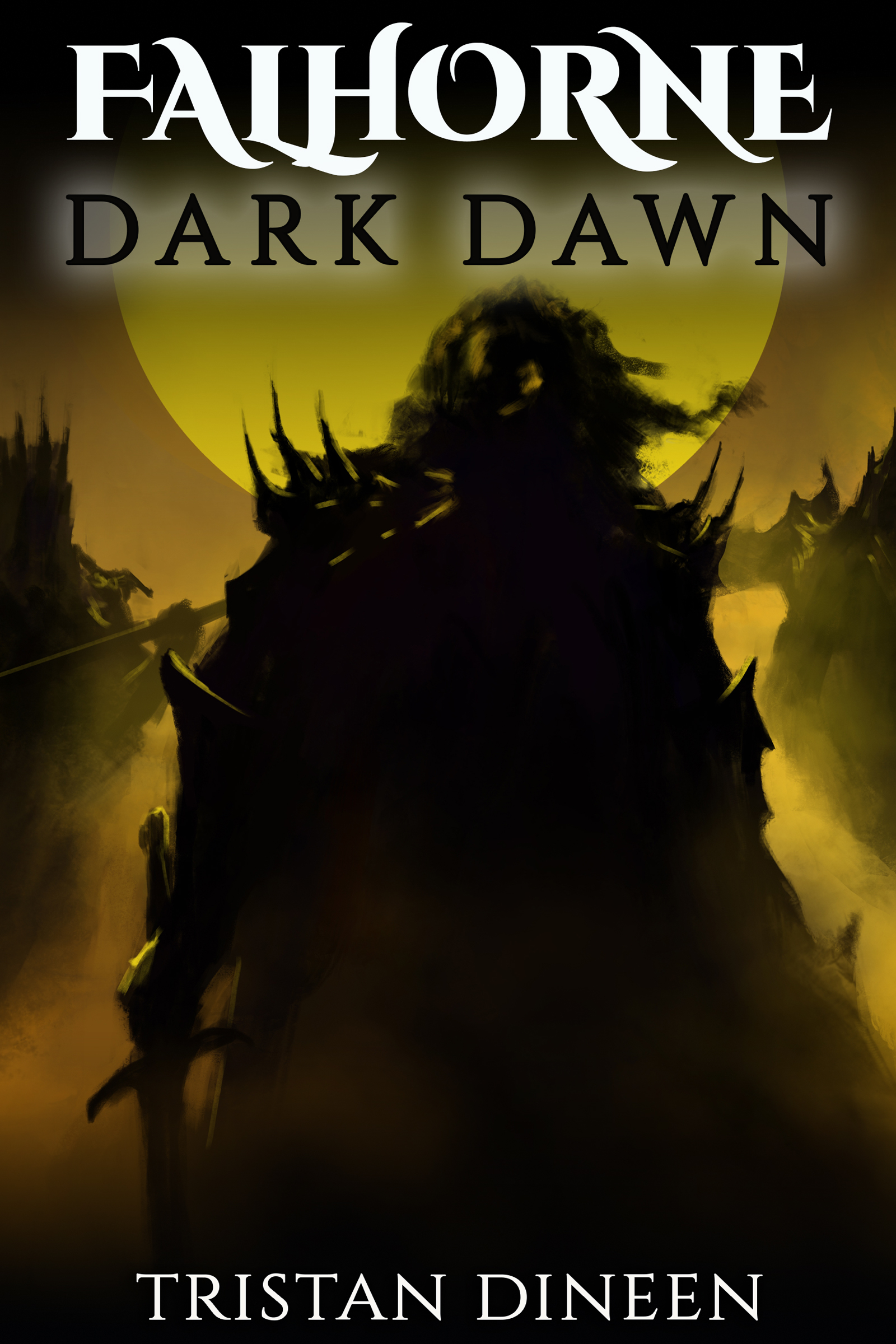
Review of Falhorne: Dark Dawn

Thank you so much Jeff Reid for this amazing review of Falhorne: Dark Dawn!

"Falhorne Book 2: Dark Dawn by Tristan Dineen
[Full disclosure, I read this book and wrote this review last year, but have been strategically holding onto it until the book's official release. Enjoy this blast from the past!]
Earlier this year, I read a draft of Tristan Dineen’s first entry into his Falhorne series, The World Is Burning. Now that the first book is set for publication in Winter 2022 (check out Tristan’s blog for more info), it feels timely to review the follow-up novel: Dark Dawn.
The book begins with a prelude that serves as a nice re-integration into the story. Forgetful readers like myself are given some time to re-immerse ourselves in the world and grow accustomed to the expectations and norms of the milieu. As a result, I felt invested from the start.
It likely helps that the novel starts in media res, beginning with action that follows the closing of the first book. The novel progresses through its storyline at a great pace. There are waves of action followed by character, plot development, and world-building. In some ways, the story reads as episodic, but in the best of ways. More so than in Falhorne Book I, its follow-up feels like the story gets to linger for longer stretches of time in different locations in different phases of the journey. For instance, several of the chapters take place in a prison cell, while another takes place exploring the depths of an ominous pyramid, and later there are several chapters that take place at camp as the heroes plan an assault. The first book passed by at quite a clip; the second allows more space for the scenes to breathe and it’s quite refreshing. The story still feels like it’s moving forward, but the phases of the story feel more secure. Even the scenes that might present as a ‘drag’ in other novels (e.g. the heroes hatching their plan) are balanced by moments of character development or thematic insights.
I feel that in this volume there are more memorable moments that leap out at me. I will try to avoid spoiling too much, but Tagus (our central character) is placed in a variety of situations that I found to be ethically and emotionally compelling. For instance, in one moment he must fight against slaves for the entertainment of their collective owner. It’s a moment where the combatants are there through no fault of their own yet nonetheless are required to be ruthless to one another. In another moment, Tagus must sacrifice his friend – or at least pretend to – and it’s a compelling dilemma. This book sees the culmination of several storylines hinted at in its precursor; Tagus encounters several people from his past and to avoid spoiling things I can’t mention the outcomes, but each one has an emotive power that makes the moment stand out. We also see a profound transformation, but again I cannot jump too far ahead with spoilers.
In terms of character, I think the second volume paints a much more full portrait of the central heroes and establishes a more well-rounded vision of them. This is particularly true for the central character, Tagus, who is given more depth and nuance than in the initial volume. He still retains the core of himself, but the events he faces force him into some introspection and cause some shifts in his beliefs that pay off nicely, particularly against his rigidity in Book I. My favourite character, Corrie, is a bit more absent from this volume, but other characters fill the void of her absence. The central ‘sidekick’ figures, while perhaps less emotionally-developed, are compelling additions to Tagus’ quest. There’s Suthis, a mysterious and conspiratorial lizardman with magic powers and Shaku, the minotaur, with shapeshifting tattoos along his face. These characters were welcome additions to the regular cast of characters and offered a nice counterpoint to Tagus’ proficiencies. [Incidentally, as a fan of classic JRPGs, the novel presents itself as a great template for a potential video game. There’s a clearly established quest that has to go onto various tangents as it becomes more complex, the party members have contrasting abilities and drift in and out of the team, and so on. It’s a novel ripe for adaptation.]
There’s another element in Falhorne Book II that I think makes it successful as a narrative and helps it to offer something different from the first book. In Book I, the world is established and the audience is aligned with Tagus, who already understands how things are. We are thrown into the situation and expected to pick up on what’s happening. In Book II, there are a series of events that render Tagus a “fish out of water” and the audience experiences that alongside him. It’s a nice shift in the focalization and it also gives Dineen more opportunity to develop Tagus’ character as well-rounded. As he becomes more unstable in his own world, the audience enhances our connection to him.
When it comes to the action scenes of the book, there are a few that stand out, especially when there are ethical consequences (cf. the moment where Tagus fights against slaves). Some of the bigger ‘set pieces’ are Dineen at his best. I found myself engrossed in the chapters where the heroes descend into the pyramid and the various battles that happen along the way. Adding to the drama of the battle is that the setting is established with such rich description, which is characteristic of Dineen’s work.
The end result is a really nice reflection of the years of work he’s put into this book. The story is well-constructed, the setting and imagery are compelling, and the balance of character development, theme, and action makes the follow-up Falhorne book an even stronger book than its predecessor.
For all of you fantasy fans: dive in. Happy reading!"


Unheroes: The Heroic Undead

 Characters in Champion's Road: Hell March “Meditation on inevitable death should be performed daily. Everyday when one’s body and mind...